
Patients often ask me why an appliance that fit well a year ago suddenly feels loose. The answer has little to do with the appliance. It is the bone underneath that has changed, and that change is what leads to the shifting fit.
Do Partial Dentures Cause Bone Loss?
They contribute to it, though they are not where it starts. Bone loss begins the moment a tooth root is gone, whether the tooth was lost to decay, injury, or extraction, and it would continue even if you never wore anything. Partial dentures are removable appliances that rest on the gum and clasp onto the natural teeth still present. They restore appearance and some chewing function, but because dentures sit on top of the tissue rather than replacing the tooth roots, they cannot stop the ridge shrinking underneath. Traditional dentures of any kind share this limitation, and full dentures have it across a wider area.
They also add to it. Chewing force passes through the appliance and onto the ridge rather than into it through a root, which is not how bone is built to receive load, and comparative studies have consistently found more ridge reduction in denture wearers than in patients who went without. So the accurate answer is that a partial denture accelerates a process it did not start. An appliance that fits poorly or is worn around the clock does more of this than a well-maintained one, which is why fit is worth staying on top of rather than adjusting around.
Tooth Loss, Bone Health, and Why the Two Are Linked
Your jaw needs a tooth root to stay stimulated. Once that stimulation disappears, the bone has nothing to respond to and the body begins resorbing it. This is not something that starts years later: bone begins to shrink within the first few months, and bone resorption continues for as long as the missing tooth goes unreplaced by something that restores stimulation at root level. Only a dental implant does that, which is why implants and bone health are discussed together so often.
What Changes Over Time
| Stage | What is happening in the bone | What the patient notices |
| Right after extraction | Resorption begins almost immediately with no root to preserve bone height | The denture usually still fits well |
| First one to two years | Ridge height and width continue to decrease | A loose partial denture that rocks or shifts while eating |
| Several years in | Loss of bone becomes more extensive and affects the surrounding bone structure | Clasps loosen, sore spots develop, the appliance needs frequent relining |
The progression below shows a side view of a human jaw. We can see how a normal, healthy jaw with all teeth present begins to shrink shortly after three extractions. The patient may be fitted with a partial denture to assist with function, but in the absence of teeth roots in the jaw, the bone melts away. Over time the bone loss becomes more extensive from not having teeth and the partial denture becomes loose fitting over the shrinking bone. The eventual bone loss can be tremendous, as the bone never stops shrinking. If too much bone is lost, a bone graft may have to be done to build enough bone to support a dental implant. If bone loss is severe, the patient may not be a candidate for implants. This is why implants should be placed as soon as possible after the loss or extraction of teeth.
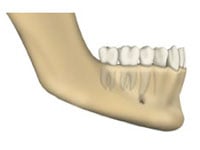
Normal, Healthy Jaw
All teeth are present
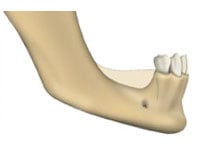
Shortly, after 3 extractions
Bone loss begins immediately upon extraction
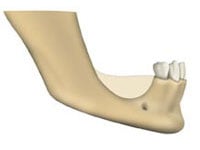
Eventual Bone Loss
A partial denture may be worn to assist with function, but beneath, the bone loss continues.
*In addition to the bone loss that happens beneath a partial denture, as the partial becomes looser, the clasps on the surrounding teeth that are holding the denture can become loose from all of the pressure.
Loose Clasps Are a Warning Sign, Not Just an Inconvenience
As bone shrinks, a partial denture that once sat snugly starts relying more heavily on the clasps attached to your remaining natural teeth. Those clasps were never designed to carry that much load. Over time the added stress can loosen or damage the very teeth holding the appliance in place, and losing one of those teeth will lead to bone loss at that site too, turning one missing tooth into several. If your dentures fit correctly when they were made and no longer do, that is worth investigating rather than adjusting around.
Will a Partial Denture Change Your Face?
Over a long enough period, yes, though it is far less dramatic than with full dentures. Facial support comes from the bone beneath the skin, so as the ridge in that area resorbs, the overlying tissue loses some of its underlying structure. With a small appliance replacing one or two teeth the change is usually subtle and localised. Where the appliance spans a larger run of missing teeth, or where it has been worn for a decade or more, the change becomes more visible. Dentures may also sit differently as this happens, which patients tend to notice before the facial change itself.
How to Prevent Bone Loss, or at Least Slow It
You cannot stop bone loss with a removable appliance alone, since nothing about it stimulates bone tissue the way a root does. What you can do is limit the secondary damage:
- Keep regular checkups so shifting is caught early rather than after the ridge has changed shape
- Have the fit of your dentures checked whenever they start to move, since an ill-fitting appliance loads the ridge unevenly
- Avoid letting the clasps put excessive strain on the natural teeth anchoring the appliance
- Maintain good oral hygiene around the clasped teeth, where decay and gum disease start most often
- Have the site evaluated for an implant sooner rather than later if a bone-preserving solution is what you eventually want
What Happens If You Have Too Much Bone Loss for Dentures?
It is possible to lose enough bone that a removable appliance no longer has a stable ridge to sit on. At that point a conventional partial or full denture becomes difficult to wear comfortably, and simply remaking it does not help, because each new appliance is built to a smaller ridge than the one before. This is usually the point at which patients ask about alternatives. Options like bone grafting can rebuild enough volume to support implants, and implant-supported dentures anchor to the bone rather than resting on it, which restores stimulation and helps maintain bone density instead of watching it decline.
Why This Matters If You Are Considering Implants Later
The more bone that is lost, the fewer options remain. Mild to moderate loss is usually manageable with modern grafting. Significant loss sometimes means a patient needs a bone graft before a dental implant is possible at all, and in the most advanced cases extensive reconstruction comes first. That is why I encourage this conversation early, ideally before or shortly after a tooth is lost, rather than after years of wearing a partial denture.
Frequently Asked Questions
What are the long-term risks of a removable partial?
Beyond the bone loss described above, the main risks are damage to the natural teeth the clasps attach to, gum irritation from an increasingly loose fit, and a steady decline in stability and comfort as the ridge changes shape.
Do partial dentures damage the other teeth?
They can, indirectly. The clasped teeth carry load they were not designed for, and the clasp itself traps plaque against the tooth surface. Neither is inevitable, but both are reasons to keep the appliance well fitted and the hygiene around it good.
What are the best dentures or alternatives if you already have bone loss?
For patients with noticeable loss, an implant-supported option, whether a single implant, an implant-supported bridge, or implant-supported dentures, is generally the better long-term choice, because it is the only approach that restores stimulation to the bone. A removable appliance still has a place as an affordable, non-surgical interim step.
Can you still wear dentures if you have bone loss?
Usually yes. The appliance can be remade to match your current ridge. The question is how long that remains comfortable, and whether you would rather address the cause now while more bone remains.
What I Recommend
If your partial feels different from when you first got it, that is usually the bone talking, not the tooth replacement itself. I would rather see you for an evaluation now than wait until the fit has become bad enough that your options have narrowed.
Schedule Your Free Dental Implants Consultation
We will look at your jaw, gum, and bone structure and tell you exactly where things stand and what your options are today. Call our office at (347) 493-2439 or schedule your consultation online.