
Patients with severe bone loss in the upper jaw are often told the only path to dental implants is extensive bone grafting, sometimes multiple rounds of it, stretched out over many months. That is not always true. Zygomatic implants offer a graftless alternative for many of these cases, anchoring into the zygomatic bone, the cheekbone, rather than the resorbed ridge of the upper jaw.
We place zygomatic implants. We also tell a good number of the patients referred to us for them that they do not need them, which is the part of this page worth reading if you have already been given a quote somewhere else.
What Are Zygomatic Dental Implants?
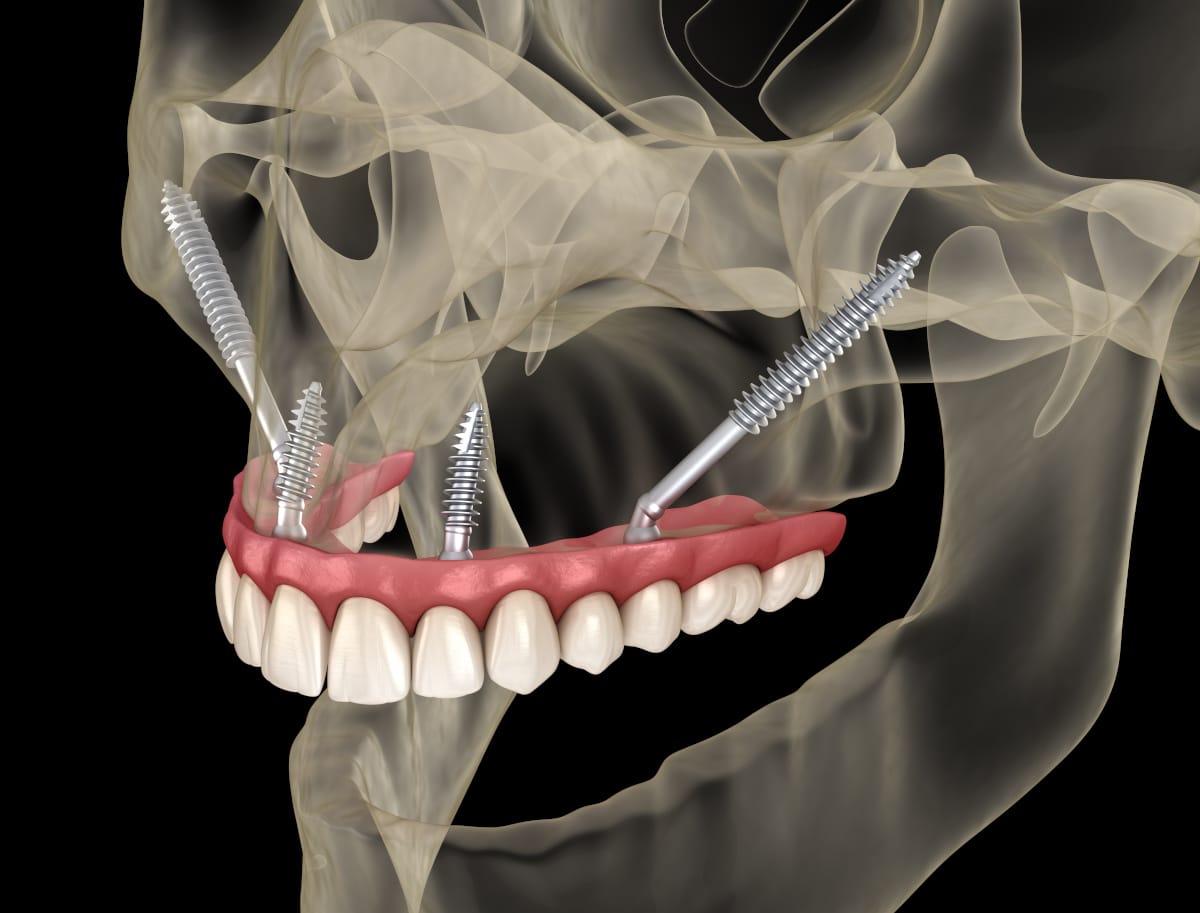
A zygomatic implant is a longer dental implant designed to anchor into the dense zygomatic bone instead of the jawbone itself. Unlike conventional dental implants, which require adequate bone volume in the jaw to stay stable, zygomatic implants are designed specifically to bypass that requirement by reaching into bone that is not affected by the resorption that follows tooth loss and denture wear.
These are extra-long implants, considerably longer than regular dental implants, angled upward from the upper jaw into the zygomatic arch. Two zygomatic implants per side is a common configuration in severe cases, sometimes described as a quad zygoma arrangement.
How Zygomatic Implants Differ From Traditional Dental Implants
Traditional dental implants are placed directly into the jawbone at the site of the missing teeth, which means there needs to be enough bone density and volume to support them. Zygomatic implants are longer and angled to anchor into the zygomatic bone instead, which means there is no need for bone grafting even in cases of severe upper jaw bone loss.
The tradeoff is real. Zygomatic implant placement is a more specialized procedure than regular implant placement, the surgical path is longer, and the complication profile is different. That is why it belongs with clinicians who perform it regularly, and why it should be reserved for patients who genuinely need it rather than offered as a default answer to bone loss in the upper jaw.
Why Many Patients Told They Need Zygomatic Implants Turn Out Not To
This is the most useful thing we can tell you, and it is based on what actually walks through our door.
More often than not, a patient referred to us having been told they need zygomatic implants, or quad zygomatics, turns out to have another route available. Bone loss in the upper jaw is not uniform. It concentrates in particular regions, and what looks like a hopeless maxilla on a panoramic X-ray frequently has usable bone in places a 3D scan will find and a two-dimensional image will not.
Where that is the case, the posterior arch can often be carried by pterygoid implants, anchored into dense bone at the back of the jaw, while tilted implants handle the front. The result is a fixed full arch without going near the cheekbone. Same outcome, shorter surgical path, different complication profile.
None of this means zygomatic implants are wrong. When they are indicated, they work, and we place them. It means the recommendation deserves a second look before you commit, because the assessment that produced it may not have had the imaging to see the alternatives.

Zygomatic, Pterygoid And Transnasal Implants Compared
| Zygomatic | Pterygoid | Transnasal | |
| Anchors into | Zygomatic bone, the cheekbone | Pterygoid plate, via the maxillary tuberosity | Cortical bone along the lateral nasal wall |
| Addresses | Severe generalized upper jaw bone loss | Bone loss at the back of the upper jaw | Bone loss at the front, as a quad zygoma alternative |
| Surgical path | Longest, past the sinus toward the orbit | Contained within the mouth | Through the region beside the nasal cavity |
| Main complication | Sinusitis | Access and jaw stiffness | Fewer long-term data available |
These are not competing products. They are different tools for different patterns of bone loss, and a full arch plan often combines more than one.
Why This Approach Works When Grafting Will Not
The zygomatic bone is dense and largely unaffected by the resorption that occurs in the upper jaw after tooth loss. By placing longer implants that anchor into this bone instead of the thinned ridge, we can provide a stable foundation for a full arch restoration without the extensive grafting that would otherwise be required. This is often the option for patients who have been told they are not candidates for traditional dental implants, including those who have already tried grafting without adequate success.
Grafting is not a guaranteed answer either. It typically adds around three months of healing before implant placement can begin, and longer for larger reconstructions, carries its own risk of partial failure, and in patients with long-standing atrophy sometimes does not produce enough bone in the upper jaw to work with.
Tilted Placement And Guided Planning
We have used tilted implant techniques, including zygomatic and pterygoid placement, for a long time to help patients with significant jaw bone loss avoid extensive grafting procedures. Careful digital planning using cone beam computed tomography is what makes this precise. We map the exact position and angle needed to anchor securely in the zygomatic bone before ever making an incision, and that same scan is what reveals whether a less invasive route exists.
What To Expect From Zygomatic Implant Surgery
Because zygomatic implants bypass the grafting and healing time required by traditional implants in resorbed bone, treatment proceeds considerably faster. Zygomatic implant surgery is performed under sedation or general anesthesia in a surgical setting. In appropriate cases we complete the entire process in a single appointment using our Teeth-In-A-Day™ solution, letting you leave with a fixed, functional set of teeth in the upper jaw rather than waiting through a lengthy healing period.
Who Is A Candidate For Zygomatic Implants?
Zygomatic dental implants tend to be the right fit for patients who:
- Have severe bone loss in the upper jaw that would otherwise require extensive grafting
- Have been told by another provider that they are not candidates for traditional dental implants
- Have tried bone grafting previously without adequate success
- Want to avoid a long, multi-stage grafting and healing process
- Are currently wearing an upper denture and want a fixed, implant-supported alternative
- Have bone loss extending across the front of the arch as well as the back, where pterygoid support alone is not enough
A thorough evaluation, including 3D imaging of your jaw and sinus anatomy, is the only way to confirm whether you are an ideal candidate for zygomatic implants, or whether something less involved would serve you better.
Success Rates For Zygomatic Implants
The evidence base is large. A 2023 International Team for Implantology consensus report, drawing on systematic review, put long-term zygomatic implant survival at 96.2% over a mean follow-up of just over six years. An earlier review of 68 studies covering 4,556 zygomatic implants in 2,161 patients reported a 12-year cumulative survival rate of 95.21%.
Two patterns matter to patients. Implant failure concentrates early, mostly within the first six months and typically around the abutment connection stage, so problems tend to surface quickly rather than years later. And immediately loaded zygomatic implants showed statistically better survival than those restored on a delayed protocol, which supports same-day treatment rather than staged treatment where the case allows it.
Risks, Complications And The Sinusitis Question
Zygomatic implant surgery is safe and predictable in experienced hands, but the honest answer to the pros and cons question includes a complication that most pages skip.
Sinusitis is the main one. The ITI consensus put its prevalence at 14.2% across a mean follow-up of around five and a half years, describing it as the most common complication and one that can lead to zygomatic implant loss. Crucially, it can appear years after surgery rather than immediately. Reported rates vary considerably by surgical technique, and the extra-sinus approaches show lower rates than the original intra-sinus technique.
Other reported complications include soft tissue infection around the implant, temporary paresthesia, and oroantral fistula. Rates for all of these are single-digit percentages in most series, and again vary by technique.
This is the reason we do not treat zygomatic implants as a first answer. Where a pterygoid or tilted approach achieves the same fixed result without a trajectory that passes the maxillary sinus, the complication profile is simply better. Where zygomatic implants are genuinely the right answer, these are manageable risks worth accepting, and you should know about them beforehand rather than afterwards.
What Do Zygomatic Dental Implants Cost?
Cost depends on the case. How many implants the arch needs, whether one arch or both are being treated, the type of final dental restoration, and whether any preparatory dental care is required all move the number.
The useful comparison is not against a single conventional implant, it is against the full alternative. Extensive bone grafting followed by regular implants involves multiple surgical stages, months of additional healing, and its own fees, and a zygomatic implant treatment plan that avoids all of that is frequently competitive on total cost even though the individual procedure is more advanced.
We go through the numbers in full at consultation, and we offer financing through CareCredit, Lending Club, Alphaeon, Cherry and Sunbit.
Does Dental Insurance Cover Zygomatic Implants?
Coverage varies widely. Many dental insurance plans treat implants as a major restorative service with an annual maximum well below the cost of full arch treatment, and some exclude implants altogether. Where a plan does contribute, it more often applies to the restoration than to the surgical placement.
Our team will review your plan with you and tell you plainly what it is likely to cover before you commit to anything.
Schedule Your Consultation
If you have been told you are not a candidate for traditional dental implants due to bone loss, or you have been quoted for zygomatic implants and want a second opinion before committing, it is worth an hour of your time.
Call our office at (347) 493-2439 or schedule your consultation online. We see patients in Manhattan, Nutley, NJ, Long Island and Bronxville.
Frequently Asked Questions
What are the benefits of zygomatic implants over bone grafting? Speed, mainly. Because zygomatic implants anchor into bone that does not need to be rebuilt, patients can often move straight to a full arch restoration without the months of healing that bone grafting requires.
Is oral surgery for zygomatic implants performed in a hospital? It depends on the complexity of your case and your medical history. Many cases can be completed in an appropriately equipped office surgical suite, though we will let you know during your evaluation if a hospital or surgical center setting makes more sense for you.
How long do zygomatic implants last? Published data follows them out twelve years with a cumulative survival rate above 95%. The implant is distinct from the prosthesis attached to it, and the prosthesis may need maintenance or replacement over time while the implants remain in place.
Are zygomatic implants safe? In experienced hands, yes, with the caveats above. The complication that deserves most attention is sinusitis, which is why technique and planning matter and why the alternatives are worth exploring first.
Can zygomatic implants be combined with traditional implants? Frequently. A common configuration places zygomatic implants at the back of the arch and regular dental implants at the front, splinted together into one fixed bridge.
Does zygomatic implant surgery hurt? Not during the procedure, which is done under sedation or general anesthesia. Afterwards, swelling and soreness are normal for several days and are managed with medication.
What if I have already been quoted for zygomatic implants elsewhere? Bring the scan and the treatment plan. We will look at both and tell you whether we agree, including if the answer is that the original recommendation was right.