The question patients ask me before this procedure is almost always the same one: are the teeth I walk out with the teeth I keep? It is worth answering plainly, because a lot of what is written about same-day implants dodges it.
You leave with a fixed bridge screwed onto implants, the same day, in a single appointment. That bridge is a long-term provisional. It is not a denture, it does not come out, and it is not something you are managing until “the real thing” arrives in a few weeks. It does its job for months, sometimes years. The final restoration comes later, once the bone around the implants has integrated and we know exactly what we are building on.
Everything below explains why it works that way, and why I think it is the right way round.
What Teeth in an Hour™ Is
Teeth-in-an-Hour™ is an immediate-load dental implant protocol, developed by Nobel Biocare and built around computer-guided surgery. Implants are placed and a fixed bridge is attached to them in the same visit, rather than placing implants, closing the gum over them, and waiting several months before anything is fitted.
That is the difference from traditional dental implants, where the sequence is deliberately broken into stages separated by healing time. Here the entire procedure happens in one appointment.
The hour refers to the surgical appointment, not to the treatment as a whole. By the time you are in the chair, the planning is finished: your anatomy has been mapped, the implant positions decided, the surgical guide made, and the bridge fabricated to fit those positions. The appointment executes a plan rather than making decisions on the day.
That is also why it is a shorter and more minimally invasive procedure than conventional implant surgery. Because the guide places implants through the gum tissue, most cases need no flap raised and no sutures, which is where a lot of the swelling and soreness in traditional implant surgery comes from. Less postoperative discomfort is the direct result.
What You Leave Wearing
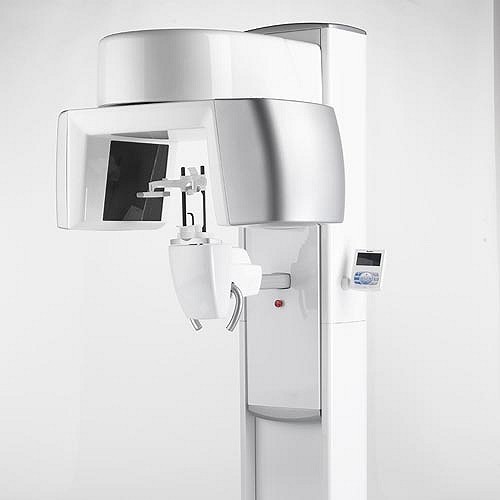
A long-term provisional. Some of my colleagues call it a prototype, and that word describes it better than most patients expect.
It is a full fixed bridge, a prosthesis attached to the implants, and you eat and speak with it normally. What separates it from the final restoration is not quality. It is that the final prosthesis is made once we know how the bone has healed, how your bite has settled, and how the gum has matured around the implants. Those things move in the first months after surgery. A restoration made before they settle is a restoration made to measurements that are about to change.
I avoid the word “temporary” for this, because it gives patients the wrong picture. A temporary crown is a placeholder you tolerate for two weeks. This is a set of fully functioning teeth you live with while your mouth finishes healing.
The interval before the final restoration is measured in months rather than weeks, and it varies with how much healing the site needed and whether any grafting was involved. I will give you a timeline specific to your case once I have seen your scan.
How the Technique Got Here
This is worth understanding, because the answer to “is it permanent?” has changed as the materials have.
Teeth in an Hour™ was originally a titanium frame with acrylic teeth, developed before zirconia and before 3D printing existed in dentistry. Patients left with that frame, and it lasted years. It was always a long-term provisional, but at the time it was also close to the best available result.
Smile in a Day™ evolved out of that approach, also built as a metal framework with acrylic teeth, also a long-term provisional.
Once 3D printing became available, the provisional changed. It could be printed rather than fabricated by hand, followed by a zirconia final restoration. That shift lowered the cost of the provisional stage and gave patients a better final result than the acrylic version they would previously have kept.
The metal versions have not disappeared. I still use them for FP1 cases, where the restoration replaces the crowns of the teeth only and sits close to the gum, because a printed bridge at that thickness would not be strong enough.
So when you read older material describing Teeth in an Hour™ as delivering permanent teeth in a day, it is describing a protocol where the day-one bridge was what you kept. That is not how I do it now, and the current sequence gives a better result.
The Planning That Makes One Hour Possible
The appointment is short because the work happens before it.
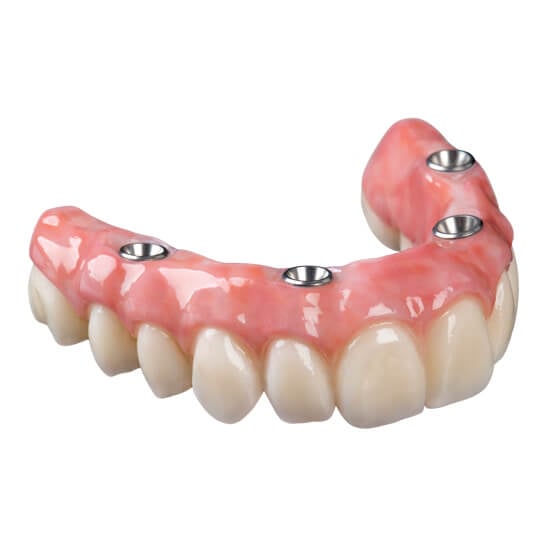
3D imaging. A cone beam CT scan, which patients often know as a CAT scan, maps the height, width and density of your jawbone along with the position of nerves, blood vessels and sinus cavities. A three-dimensional model of the jawbone is generated from it. This is what determines whether the procedure is possible at all, and where each dental implant can safely go.
[IMAGE: scan.jpg — carried across from /teeth-in-an-hour-explained/]
Digital planning. Implant positions are planned against that scan, not estimated during surgery. Angulation, depth and spacing are all decided in advance, which is what makes precise implant placement achievable rather than aspirational.
A surgical guide. The plan is converted into a guide that seats over your jaw and directs each implant to its planned position. This is what allows placement through the gum tissue without opening a flap.
A bridge made to the plan. Because the implant positions are known before surgery, the provisional bridge is fabricated to fit them ahead of the appointment. This is also where the restorative side of the treatment and the surgical side have to agree completely, since the bridge is built to a position the implants have not yet been placed in.
Teeth in an Hour™, Smile in a Day™, and All-on-4™
Patients often arrive having read about all three and assuming they are competing products. They are related approaches to the same problem, and the differences are mostly in scope and history.
| What it addresses | Day-one result | |
|---|---|---|
| Teeth in an Hour™ | Guided, flapless placement with a bridge fitted the same visit | Fixed long-term provisional |
| Smile in a Day™ | Our full-arch protocol combining flapless guided surgery with same-day extractions | Fixed long-term provisional |
| All-on-4™ | A full arch supported on four implants, including tilted placement to avoid grafting | Fixed long-term provisional |
All three deliver a fixed bridge on the day, and in all three the final restoration follows later. If you are weighing a full arch specifically, the All-on-4™ page and the Smile in a Day™ page go into more detail on each.
Who This Suits
Teeth in an Hour™ works when the planning confirms three things.
Enough bone, in the right places. Immediate loading asks the implants to carry a bridge straight away, so they need sufficient bone to be stable at placement. The CT scan answers this before anything is committed to.
Healthy gums. Active periodontal disease needs treating first. Placing implants into infected tissue is how implants fail.
A bite the plan can accommodate. Heavy grinding, or a bite that loads the front of the arch hard, changes what is sensible on day one.
Patients currently in dentures are often good candidates, and they are the group who notice the difference most, because a fixed bridge does not move, does not need adhesive, and does not rest on a ridge that is still shrinking.
Who is not a good candidate: anyone whose jawbone cannot hold a dental implant stable enough to load on the day, anyone with untreated gum disease, and anyone whose bite would put the bridge under more force than a healing implant should carry. Uncontrolled diabetes and heavy smoking both work against integration and are worth discussing honestly before we plan anything.
Where It Is Not the Answer
If the scan shows insufficient bone volume, grafting comes first, and grafting has its own healing time. That extends the treatment well beyond a single visit, and I would rather tell you that at the consultation than discover it mid-procedure. You can read more about bone grafting if that is likely to apply to you.
If teeth need extracting first and the sockets need to settle, that also changes the timeline.
And as with any implant treatment, there is a risk that an individual implant fails to integrate. It is uncommon, and when it happens the implant is removed and replaced. What I will say about our own outcomes is that no patient of ours has left without a fixed bridge in their mouth. Individual implants can fail; patients do not go back to a removable denture.
What Happens After the Day
You go home with a fixed bridge and a set of instructions that matter more than usual, because the implants are healing while carrying load.
A soft diet through the early part of healing is standard, and I will tell you how long to stay on it and when to progress, based on how many implants were placed and how they seated. Hygiene around a fixed full-arch bridge needs a threader or a water flosser, since you cannot floss between the units the way you would between natural teeth.
Because there is usually no incision, most patients resume their normal activities the next day. That is not the same as the implants being finished healing. The healing time underneath continues for months while you are getting on with your life, which is rather the point of the protocol.
I will see you through healing, and the final restoration is made and fitted once the site is stable.
What Affects the Cost
Teeth in an Hour™ is priced case by case, because the variables genuinely differ from patient to patient:
- How many implants the arch needs. This is the single largest factor.
- Whether extractions are part of the same appointment.
- Whether grafting is needed first. Rebuilding bone adds a stage before implants can be placed.
- Which materials the provisional and final restoration use. A printed provisional and a zirconia final differ in cost from a metal framework build.
- Whether one arch or both are being treated.
- Insurance. Coverage for implant work varies widely between plans.
I will give you an exact cost as part of your treatment plan at your consultation, with your insurance and financing options set out alongside it.
Frequently Asked Questions
Do you actually get permanent teeth in one hour? You get a fixed bridge on implants in one visit, and it stays in your mouth. It is a long-term provisional rather than the final restoration, which is made later once healing has settled. Anyone promising a permanent final bridge on the day of surgery is either using older terminology or overstating what is possible.
How long does the appointment take? The surgical appointment is around an hour for a planned case. Add the consultation and scan beforehand, and a follow-up afterwards, and most patients attend three appointments before the final restoration stage.
Is it Teeth in an Hour painful? Less than patients expect, and less than conventional implant surgery. Because the implants go through the gum tissue rather than through a raised flap, there is usually no incision and no sutures, which is where most post-operative swelling comes from. The procedure is done under local anesthetic, with sedation available if you would prefer it.
Do I need a bone graft? Not necessarily, and one of the points of planning against a CT scan is to answer this before treatment starts rather than during it. If the scan shows enough bone at the planned implant positions, no graft is needed. If it does not, grafting comes first.
How does Teeth in an Hour compare to traditional dental implants? With traditional dental implants, a tooth is extracted, the socket heals for three to four months, the implant is placed, and the site heals again before a crown or bridge goes on. Teeth-in-an-Hour™ compresses the surgical stage into a single procedure and gives you a fixed bridge on the day, but the biology underneath is the same. Bone still needs to integrate around each implant, and the final prosthesis still waits for that.
Can it replace a single tooth, or is it only for a full arch? The guided, immediate-load approach is used across both, but the full-arch case is where it makes the biggest difference to a patient’s life. For a single missing tooth, a single implant-supported crown is usually the more straightforward route.
Will insurance cover it? Many plans exclude implants entirely while covering less expensive alternatives, and those that do cover implants generally have an annual maximum well below the cost of full-arch treatment. We check your benefits before your visit and go through financing options with you.
What if an implant fails? It is removed and replaced, and the bridge stays in your mouth throughout. Failures are uncommon, and they are recoverable.
Schedule Your Consultation
If you want to know whether Teeth in an Hour™ is possible in your case, the answer comes from a scan rather than a conversation. Come in, let us look at your bone, and we will tell you what is achievable and what the sequence would be.
Call our office at (347) 493-2439 or schedule your consultation online.