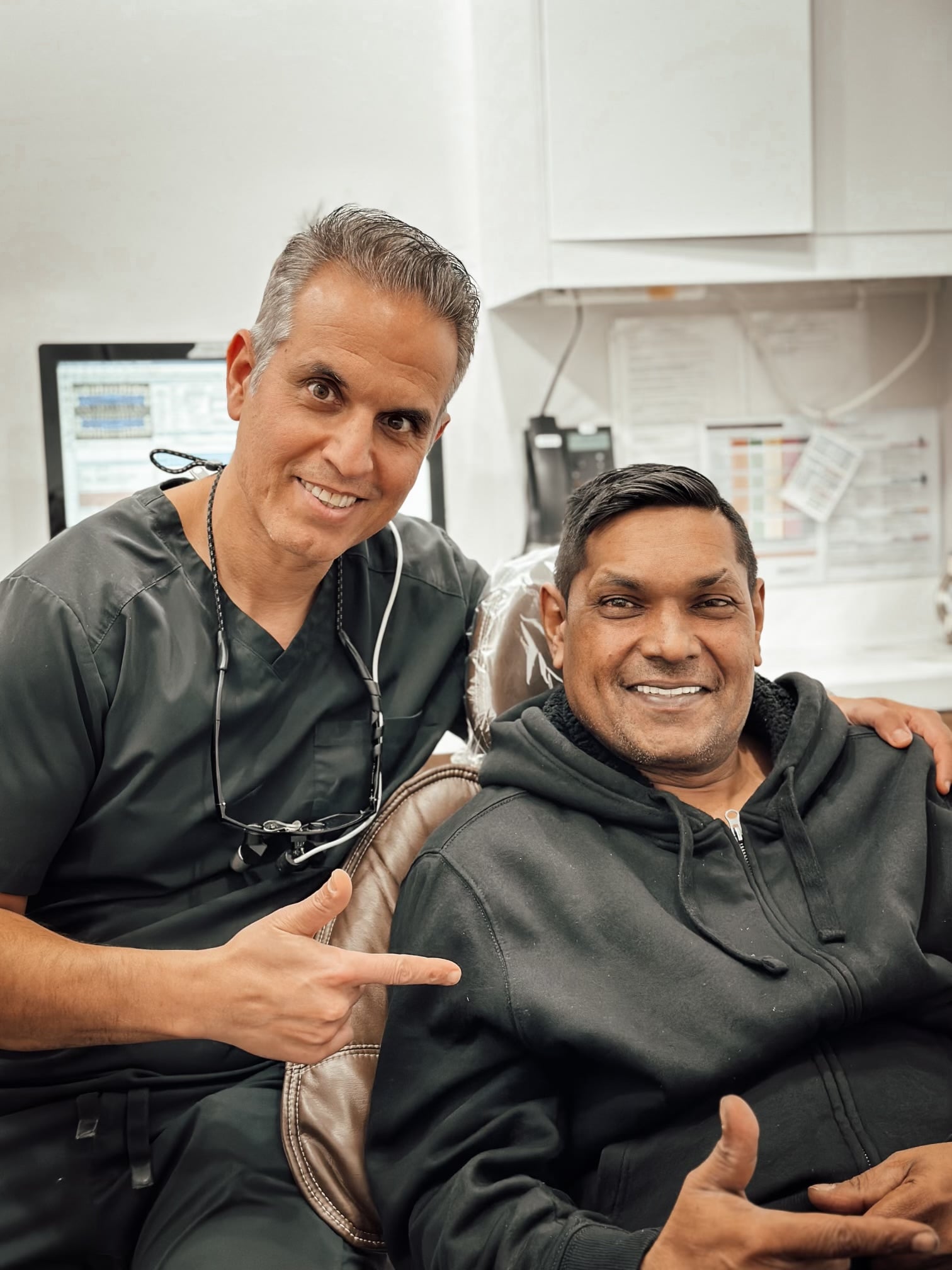

If your denture slips when you eat, rubs sore spots into your gums, or needs a layer of adhesive every morning to stay put, snap-in dentures are usually the first upgrade worth looking at. A snap-in denture clips onto a small number of dental implants, so it stays in place when you chew and speak, but you still take it out each night to clean it. We place and restore snap-in implant dentures at our Manhattan, Bronxville, Long Island and Nutley, NJ offices.
Snap-In Dentures Explained: What Are They?
Snap-in dentures, snap-on dentures and snap dentures are patient terms for the same treatment. Clinically, it is called an implant-retained overdenture: a full denture that fits over, and attaches to, implants placed in the jawbone. Some practices call them implant dentures, implant-retained dentures or implant-supported dentures. If you have seen all of these names and wondered whether they are different procedures, they are not.
“Overdenture” is the wider term. Most overdentures are anchored by implants, and that is what most people mean when they search for snap-in dentures. An overdenture can also be supported by a few of your remaining natural teeth, which we cover further down. Tooth-supported overdentures don’t snap onto anything, so we treat them as a variant rather than the same thing.
A traditional denture rests on the gums and relies on suction or adhesive. Unlike conventional dentures, an overdenture is attached to implants, so the implants carry the load. Unlike fixed dentures, it is not screwed in place. It sits in the middle: implant-retained, but removable.
How Snap-In Implant Dentures Work
Implants are placed in the jaw and left to bond with the bone through a process called osseointegration. Once they are stable, an attachment is fitted to the top of each implant, and matching housings are set into the underside of the denture. When you press the denture into place, the housings snap onto the dental implants and lock it in. To take it out, you lift it off the implants with your fingers.
There are two common ways to connect the denture to the implants:
- Individual attachments. Each implant carries its own small ball or locator-style abutment, and the denture clips onto each one separately. This is the most common design.
- Bar-retained dentures. A thin custom metal bar joins the implants together, and clips in the denture grip the bar. A bar spreads the bite force across all the implants, which can help when the bone is softer or the implants are placed at different angles.
Either way, using dental implants to retain the denture replaces the suction and adhesive a regular denture depends on, which is why they are much more stable and comfortable for most people.

Snap-In Dentures Vs. Traditional Dentures And Fixed Dentures
Most patients we see are choosing between three options. This is how they compare:
| Traditional Dentures | Snap-In Dentures (Overdentures) | Fixed Implant Dentures | |
|---|---|---|---|
| What holds them in | Suction and adhesive on the gums | Two to four dental implants per arch | Four or more implants, screwed in |
| Removable? | Yes | Yes, taken out daily to clean | No, only your periodontist removes it |
| Stability when eating | Can rock and slip | Secure fit, little movement | Feels most like natural teeth |
| Covers the palate (upper) | Yes | Often reduced, depending on implant number | No |
| Effect on the jawbone | Bone keeps shrinking | Implants help preserve bone where placed | Implants help preserve bone where placed |
| Relative cost | Lowest | Middle | Highest |
If you are deciding between a removable and a fixed option, our page on fixed bridges explains the difference in more detail, and our All-on-4™ page covers the most common fixed full-arch approach.
Are Snap-In Dentures Permanent?
No. This is the most common point of confusion, and some advertising makes it worse by calling them “permanent.” The implants are permanent. The denture is not: snap-in dentures are removable dentures, and you take them out every day to clean them and give your gums a rest. If you want teeth that stay in and never come out, you are looking for a fixed, non-removable bridge instead. We explain that distinction on our page on permanent dentures vs. dental implants.
Benefits Of Snap-In Dentures
- A secure fit. A denture supported by dental implants locks in place, so it does not lift when you bite into an apple or shift when you laugh.
- No denture adhesive. The implants retain the denture, so creams and powders are usually no longer needed.
- Better chewing. A stable denture lets you bite harder and eat a wider range of foods than a conventional denture allows.
- Clearer speech. Less movement means less clicking and fewer words you have to think about.
- A natural-looking smile. The teeth are custom-made to suit your face, and a stable denture has a more natural feel when you talk and smile.
- Fewer sore spots. A denture that doesn’t slide around rubs the gums less.
- Bone preservation where the implants sit. Implants load the jawbone the way tooth roots do, which helps slow the bone loss that follows tooth loss.
- Less palate coverage. With enough implants, an upper snap-in denture can often be made with less plastic over the roof of the mouth, which helps taste and comfort.
- Lower cost than a fixed bridge. Fewer implants and a simpler prosthesis make an overdenture a more affordable upgrade in comfort and function, without the full cost of fixed teeth.
Drawbacks Of Snap-In Dentures
An overdenture is a good option for a lot of people, but it’s worth knowing the benefits and drawbacks before you commit:
- It still comes out. You remove and clean it daily, and most people take it out at night. If that is the part of denture life you want to leave behind, a fixed bridge is the better fit.
- Some movement remains. A snap-in denture is much more stable than a regular denture but not as rigid as fixed teeth, especially when only two implants are used.
- The attachments wear. The nylon inserts that grip the implants lose their hold with use and need replacing periodically. Each replacement is a short visit, but it comes with a fee, so it is an ongoing cost to budget for, not a one-time expense.
- It requires surgery. Placing the implants is a surgical procedure, and the implants need time to heal before the denture can be attached.
- Bone under the denture can still change. Areas of the jaw without implants continue to remodel, so over the years the denture may need relining to restore the fit, or eventually replaced with a new overdenture.
Who Is A Good Candidate For Snap-In Dentures?
Implant-retained dentures tend to suit patients who:
- Are missing all of their teeth in one or both arches, or will be after failing teeth are removed
- Have so many missing teeth that a partial denture or bridge is no longer practical
- Already wear a full denture and struggle with slipping, rocking or sore spots
- Want implant stability without the cost of fixed teeth
- Prefer a denture they can take out to clean
- Have enough bone for at least two implants, or are willing to have a bone graft if they don’t
Having worn removable dentures for a long time does not rule you out, even if a dentist once told you there was not enough bone. Long-term denture wearers often have lost bone, but that changes where and how we place the implants rather than whether we can help. We review your medical history and overall oral health at the consultation too, since conditions such as uncontrolled diabetes and heavy smoking affect the chances of a successful implant. A 3D CBCT scan shows us your bone density and the space available, so the plan is based on your anatomy rather than an estimate.
How Many Implants Do Snap-In Dentures Need?
It depends on the arch. A lower snap-in denture can be retained by as few as two implants, and two is a common starting point. The upper jaw has softer bone, so an upper overdenture usually needs more, typically four. More implants mean a firmer hold and allow us to cut back the palate on an upper denture. We’ll recommend a number based on your bone, your bite and how stable you want the denture to be.
Some offices place snap-in dentures on mini implants. In our experience, mini implants hold up better in the lower jaw than the upper, and we regularly see patients whose mini implants have loosened. If that has happened to you, standard implants can often be placed to rescue the case.
Tooth-Supported Overdentures
If you still have a few healthy teeth with good roots, an overdenture can sometimes be supported by those teeth instead of implants. The teeth are shortened and treated, then the denture fits over them. Keeping natural roots helps retain bone and gives the denture something to rest on, so it is more stable than a regular denture. It is not as secure as an implant-retained overdenture, and it depends on those teeth staying healthy. If they eventually fail, implants can usually be added and the overdenture converted to implant support.
The Snap-In Dentures Procedure, Step By Step
- Consultation and planning. We examine your mouth, take a CBCT scan and talk through your goals and budget. If you need any teeth removed, we plan that at the same time.
- Implant placement. The implants are placed under local anesthesia, with sedation available if you prefer. Most patients find the surgery easier than they expected, and we give you instructions to help reduce swelling and keep you comfortable afterwards.
- Healing. The implants are left to integrate with the bone. During this time you wear a denture so you are never without teeth.
- Attaching the denture. Once the implants are stable, we fit the attachments and fix the housings into your new denture, or in some cases into your existing denture if it fits well. You leave with new teeth that snap onto the implants.
- Follow-up. We check the fit and your bite and make small adjustments as you get used to the new teeth. Regular follow-up visits keep the attachments and the implants in good shape.
Caring For Snap-In Dentures
Proper care and maintenance keep both the denture and the implants healthy:
- Take the denture out daily and brush it with a soft denture brush and non-abrasive cleaner.
- Clean around each implant and attachment with a soft toothbrush. Plaque around implants can inflame the gums just as it can around natural teeth.
- Most patients remove the denture overnight so the gums can rest.
- Keep regular dental care visits so we can check the implants, your teeth and gums, and the attachments.
- Let us know if the denture starts to feel loose. That usually means the inserts are worn, which is a quick fix.

What Affects The Cost Of Snap-In Dentures
The cost varies from patient to patient. The main factors are:
- The number of implants, and whether you need one arch or both
- Whether teeth need to be removed first
- Whether a bone graft is needed to support the implants
- Individual attachments or a bar-retained design
- Whether your existing denture can be converted or a new one is made
- Sedation, if you choose it
- Your dental insurance, which may cover part of the denture or implants depending on your plan
An overdenture generally costs more than conventional dentures and less than a fixed full-arch bridge. I’ll give you an exact cost as part of your treatment plan at your consultation.
Why Patients Choose Our Practice For Overdentures
Every implant at our practice is placed by a board-certified periodontist. Periodontics is the branch of dentistry that specializes in the gums and bone that hold implants in place. Our team has placed more than 10,000 implants and regularly treats complex cases, including patients with significant bone loss and patients whose previous implant dentures have failed elsewhere. If you already have an overdenture that has become loose or uncomfortable, we can assess whether adding implants or switching to a bar design will make it more stable.
We offer overdentures at our Manhattan, Bronxville, Long Island and Nutley, NJ offices.
If loose dentures are holding you back, an overdenture can give you teeth that stay put when you need them to and come out when you want them to. We’ll help you weigh them against the alternatives and choose what suits your mouth, your budget and your routine.
Call (347) 493-2439 or book a consultation online to find out whether you are a candidate.
Frequently Asked Questions
How Long Do Snap-In Dentures Last?
With good care, the implants themselves can last a lifetime. The denture wears with daily use and typically needs remade or relined, and the attachment inserts are replaced more often.
Can I Eat Normally With Snap-In Dentures?
Most patients can eat a much wider range of foods than with a conventional denture, including salads, meat and crusty bread. Very hard or sticky foods are still best taken carefully, and there is an adjustment period while you get used to the new teeth.
Do Snap-In Dentures Need To Be Removed At Night?
We recommend taking them out overnight. It gives your gums a rest and lets you clean the denture and the implants thoroughly.
Can Snap-In Dentures Fall Out?
When the attachments are in good condition, a snap-in denture will not fall out while you eat or talk. If it starts to feel loose, the nylon inserts are usually worn and can be replaced in a short visit.
Do Snap-In Dentures Cover The Palate?
A conventional upper denture covers the whole palate. With enough implants, an upper snap-in denture can often be designed with reduced palate coverage. How much depends on the number of implants and the quality of the bone.
Can Snap-In Dentures Be Made Permanent?
The denture itself can’t be made non-removable, but the treatment can be upgraded. If you have the bone for it, additional implants can convert you to a fixed bridge later.
Can I Use My Existing Denture?
Sometimes. If your current denture fits well and is in good condition, we may be able to add the housings to it. Otherwise we make a new one designed around the implants.
Will Insurance Cover Snap-In Dentures?
Some dental plans cover part of the denture, the implants or both, while others exclude implants. Our team can check your benefits before treatment.
Are Snap-In Dentures Worth It?
For most people who struggle with a loose traditional denture, yes. They solve the biggest complaints about regular dentures, which are movement, adhesive and difficulty eating, at a lower cost than fixed teeth.