
Guided bone regeneration (GBR) is a surgical procedure that rebuilds missing jawbone so a dental implant can be placed where there is not enough bone to hold one. Bone graft material is packed into the deficient area and covered with a barrier membrane, which keeps the faster-growing gum tissue out while the slower bone cells fill the space. When the technique is used to widen or heighten the jaw ridge, it is also called ridge augmentation. Our periodontists use it routinely, and it is the reason very few patients are told today that they have too little bone for implants.
Why The Jaw Loses Bone
The jawbone depends on tooth roots for stimulation. Once a tooth is lost, the bone that held it begins to resorb, and the alveolar ridge becomes narrower and shorter over time. Common causes of bone loss include:
- Tooth loss or extraction without socket preservation, which is the most common reason.
- Periodontal disease, which destroys the bone supporting the teeth.
- Long-term denture wear, covered on our page about whether dentures cause bone loss.
- Infection, cysts or trauma to the jaw.
- In the upper back jaw, expansion of the maxillary sinus into the space left by missing teeth.
An implant needs enough bone volume around it on all sides to be stable and to stay healthy long term. When the ridge is too thin or too short, the bone has to be rebuilt first, or a graftless technique has to be used instead.
What Is Guided Bone Regeneration?
Bone heals more slowly than gum tissue. If a bone defect is simply closed over, the soft tissue fills the space before the bone can, and the defect never rebuilds. Guided bone regeneration solves that problem with a barrier membrane placed over the graft, which holds the space and excludes the soft tissue cells so bone-forming cells can populate the site.
Membranes are either resorbable, usually made of collagen and absorbed by the body as the site heals, or non-resorbable, which hold their shape well in larger defects and are removed at a second visit. Successful regeneration depends on four things: closing the wound properly, a good blood supply, a stable blood clot, and keeping the space open long enough for bone to form.
GBR, Ridge Augmentation, Ridge Preservation And Sinus Lifts
These terms overlap, and patients are often told different ones by different offices:
- Guided bone regeneration is the technique itself: graft plus barrier membrane.
- Ridge augmentation is GBR used to rebuild a ridge that has already shrunk, adding width (horizontal) or height (vertical) before an implant is placed.
- Ridge preservation, or socket preservation, is grafting at the time of an extraction to stop the ridge collapsing in the first place. Prevention is simpler than reconstruction.
- Sinus augmentation rebuilds height in the upper back jaw by lifting the sinus floor, a separate procedure for a separate problem.
- Jaw reconstruction is the broader term for rebuilding a severely resorbed jaw, sometimes with block grafts or several staged procedures.
How Guided Bone Regeneration Works
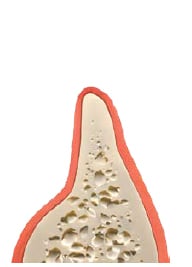
Inadequate bone width for successful implant placement
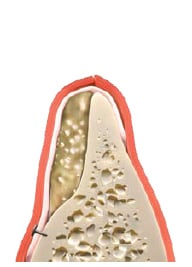
In some cases, a membrane will be used to protect and contain the graft
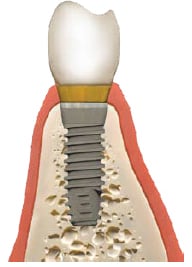
Adequate bone width regenerated for placement of a dental implant
In practice, the procedure follows the same sequence:
- Planning. A cone beam CT scan shows the exact height and width of bone available and where the graft is needed.
- Anesthesia. The area is fully numbed. Sedation options are available for patients who want them.
- Access. The gum is gently lifted to expose the defect, and the bone surface is cleaned and prepared.
- Grafting. Graft material is placed to rebuild the missing width or height.
- Membrane. A barrier membrane is shaped over the graft, sometimes secured with small tacks or screws.
- Closure. The gum is sutured over the site so it heals covered.
- Healing. The graft matures for roughly four to six months, after which the implant can be placed. Larger reconstructions take longer, and some cases need more than one graft.
Where the bone is only slightly deficient, grafting and implant placement can sometimes be done in the same visit.
Grafting Materials
Several materials work with this technique, and the choice depends on the size and shape of the defect:
- Autograft: your own bone, taken from another site. Still considered the gold standard.
- Allograft: processed human donor bone from a tissue bank.
- Xenograft: processed bone of animal origin, usually bovine.
- Alloplast: synthetic graft material.
Our page on dental implant bone grafts explains how each one behaves and when we choose it.
When The Bone Cannot Be Rebuilt
Vertical defects, where height has to be rebuilt, are more demanding than widening a ridge, and very large defects are not always suited to grafting. In those cases there are graftless options that use the bone that remains: pterygoid implants anchor behind the sinus, zygomatic implants anchor in the cheekbone, and transnasal implants are another approach for a severely resorbed upper jaw. Patients told elsewhere that only zygomatic implants would work often turn out to have an alternative, such as a graft combined with a pterygoid implant.
What Affects The Cost Of Ridge Augmentation
Bone grafting is quoted per site rather than as a single figure. The main factors are:
- How much bone is missing, and whether width, height or both need rebuilding.
- The number of sites being grafted.
- The graft material and the type of membrane used.
- Whether the graft is done at the same time as an extraction or implant placement, or as a separate procedure.
- Whether sedation is used, and what your insurance covers.
We give you a written treatment plan with the cost of your grafting and implant treatment after your consultation and scan.
Frequently Asked Questions
Is Guided Bone Regeneration Painful?
The procedure is done with local anesthesia, with sedation available, so you should not feel pain during it. Most patients describe the recovery as similar to a tooth extraction, with some swelling for a few days.
How Long Does A Bone Graft Take To Heal?
Usually four to six months before an implant can be placed, though larger reconstructions take longer. Healing time depends on the size of the graft, the material used and your general health.
What Is The Difference Between GBR And GTR?
Guided bone regeneration rebuilds bone for implant placement. Guided tissue regeneration uses the same barrier principle to regenerate the attachment around a natural tooth damaged by gum disease.
Can Jawbone Grow Back On Its Own?
No. Once the ridge has resorbed, the bone does not rebuild itself. Grafting at the time of extraction is the way to avoid losing it.
Am I Too Old For A Bone Graft?
Age itself is rarely the issue. What matters is your general health, your gum health and habits such as smoking, which slows healing.
Book A Consultation
If you have been told you do not have enough bone for dental implants, it is worth a second opinion. Our board-certified periodontists will scan your jaw and explain whether grafting, ridge augmentation or a graftless option suits your case. Call (347) 493-2439 or request a consultation online.