

A tooth-supported bridge replaces missing teeth by anchoring to the natural teeth on either side of the gap. Those two teeth are prepared for crowns and become the abutment teeth, and the artificial teeth between them, called pontics, are joined to those crowns as one fixed unit. The most common version replaces one missing tooth using the two neighbors, which is where the term “3 unit bridge” comes from: two crowns and one pontic. Longer spans are possible, and a bridge is also known as a fixed partial denture.
A dental bridge is fixed in place, restores chewing quickly and looks natural. The trade-off is that it relies on healthy neighboring teeth, and it does nothing for the bone under the gap.
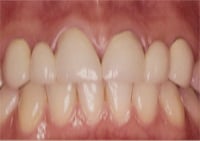
Before Treatment
Before Worn & Discoloured Bridges

Step 1
Prepared adjacent teeth
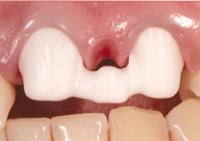
Step 2
Try-in on left quadrant
When A Tooth-Supported Bridge Makes Sense
- The teeth either side of the gap already have large fillings, crowns or decay, so preparing them for crowns costs you little healthy tooth structure.
- You want the space closed in weeks rather than months.
- Implants are ruled out by health reasons, or by bone loss you would rather not graft.
- Upfront cost or timing matters more to you than long-term bone preservation.
Where the neighboring teeth are healthy and untouched, most periodontists will steer you toward a dental implant instead, because a bridge means cutting down two sound natural teeth to replace a single missing tooth.
Types Of Dental Bridges
A tooth-supported bridge is the traditional dental bridge, and it is the most common type of dental bridge. The others differ in what holds the artificial teeth in place:
- Traditional bridge: crowns on the teeth on either side of the gap, with the false tooth or teeth between them.
- Cantilever bridge: supported on one side only, used where there is a tooth on just one side of the gap.
- Maryland bridge: a bonded bridge with wings cemented to the back of the neighboring teeth, which keeps them almost untouched.
- Implant-supported bridge: anchored on dental implants instead of natural teeth.
- Removable partial denture: not a bridge at all, but the removable alternative for the same space.
How The Bridge Is Made And Fitted
- Assessment. We check the abutment teeth, their roots and the bone around them, along with your gum health and bite.
- Preparation. The abutment teeth are reshaped under local anesthesia to make room for the crowns.
- Impressions. A digital scan or impression records the prepared teeth and the bite, and the dental laboratory builds the bridge from it.
- Temporary bridge. You leave with a temporary bridge protecting the prepared teeth.
- Fitting. The final bridge is tried in, the bite is adjusted, and it is fixed with dental cement.
Most cases take two visits over a few weeks.
Materials
- Porcelain fused to metal: a metal substructure for strength with porcelain over it. Long service record; the metal margin can show at the gumline over time.
- Zirconia: strong, metal-free, and the usual choice now for both front and back teeth.
- All-ceramic: the most natural-looking option, used mainly at the front.
- Gold alloy: kind to opposing teeth and very durable, rarely chosen for appearance reasons.
What A Bridge Does Not Do
A bridge replaces the crowns of the missing teeth, but nothing replaces the roots. The jawbone under the pontic keeps resorbing, so over the years the ridge shrinks and a gap can open under the bridge that traps food and shows when you smile. Our page on bone preservation explains why that happens.
The abutment teeth also take on the load of the missing teeth. They are more prone to decay at the crown margins and to root problems, and cleaning under the bridge needs a floss threader or a water flosser rather than ordinary flossing. If one abutment tooth fails, the whole bridge usually has to be replaced, and you are then treating a larger space than you started with.
Tooth-Supported Bridge Or Implant-Supported Bridge?
An implant-supported bridge uses dental implants rather than natural teeth as the anchors:
- Neighboring teeth: untouched with implants, reshaped for crowns with a tooth-supported bridge.
- Bone: implants stimulate and help preserve the jawbone, a bridge does not.
- Time: a few weeks for a bridge, several months for implants where healing or grafting is needed.
- Longevity: bridges are usually replaced at intervals over a lifetime; dental implants last far longer, with the crown or bridge on top serviced as needed.
- Cost: a bridge costs less up front. Replacement bridges narrow that difference over time.
For a full comparison of ways to fill a larger space, see treatment options for replacing several missing teeth, and for the other bridge designs, our dental bridges guide.
What Affects The Cost Of A 3 Unit Bridge
- The number of units, meaning crowns plus pontics. A 3-unit bridge is the baseline.
- The material chosen.
- Whether the abutment teeth need treatment first, such as fillings, root canals or gum treatment.
- Whether a temporary bridge is worn for an extended period.
- Your dental insurance plans, which often cover a share of a bridge under major restorative treatment.
Caring For Your Bridge
With proper care a dental bridge can last many years. Brush twice daily, clean under the pontic every day with a floss threader, superfloss or a water flosser, and keep up regular checkups so the abutment teeth and gums are monitored. Most failures come from decay or gum disease at the abutments rather than from the bridge itself.
Frequently Asked Questions
What Is A 3 Unit Bridge?
A dental bridge with three connected units: a crown on each abutment tooth and one replacement tooth between them. It is the most common bridge for a single missing tooth.
How Long Does A Tooth-Supported Bridge Last?
Many last a decade or more. Lifespan depends most on the health of the abutment teeth and on how well the area under the bridge is cleaned.
Can A Bridge Replace More Than One Missing Tooth?
Yes, within limits. The longer the span of teeth in a row, the more load the abutment teeth carry, and at some point dental implants become the more predictable option.
Does Getting A Dental Bridge Hurt?
The teeth are numbed for the preparation appointment, so you should not feel pain. Some sensitivity while wearing the temporary bridge is normal.
Is A Bridge Better Than An Implant?
It depends on the neighboring teeth. If they are already heavily restored, a bridge makes good use of dental work that has to be done anyway. If they are healthy, an implant avoids touching them and preserves the bone.
Book A Consultation
If you are weighing a bridge against an implant, our board-certified periodontists will assess the neighboring teeth and the bone and explain what each option means for you long term. Call (347) 493-2439 or request a consultation online.